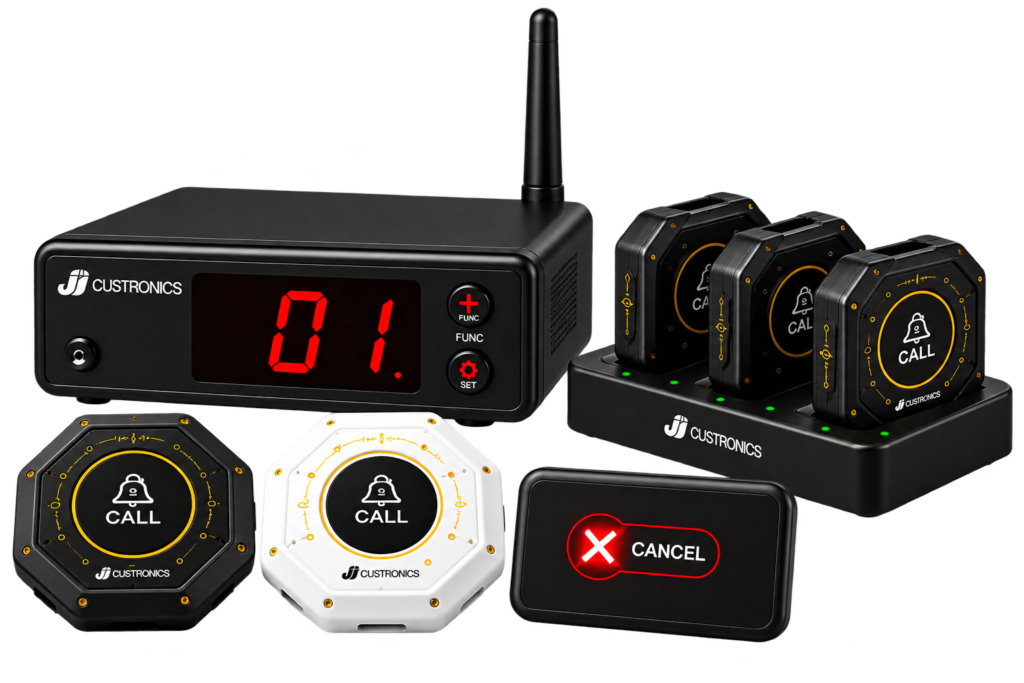
What is a Wireless Calling System, and how does it work?
A Wireless Calling System allows customers or staff to request assistance using a wireless call button. When the button is pressed, a signal is transmitted to a compatible receiver, display, pager or staff notification device, depending on the system configuration. This helps businesses respond to service requests more efficiently without relying solely on verbal communication.
Where can Wireless Calling Systems be used?
Wireless Calling Systems are suitable for a wide range of environments, including restaurants, cafés, food courts, hospitals, kliniks, customer service counters, hotels and retail outlets. For example, restaurant customers can request assistance from their tables, food court operators can notify customers when orders are ready, and hospital staff can use suitable calling solutions to request assistance. The appropriate system depends on the intended application.
What is the operating range of a Wireless Calling System?
The operating range depends on the wireless technology, product model, building layout and surrounding environment. Walls, metal structures, electrical equipment and other sources of interference may affect signal performance. For larger restaurants, multi-storey buildings or facilities with multiple service areas, we recommend assessing the installation environment and testing the signal coverage before finalizing the system.
Can the system notify staff through a display, pager or smartwatch?
Depending on the selected model, a Wireless Calling System can send notifications to compatible receivers, digital displays, pagers or wearable notification devices. These options help staff identify incoming calls and respond promptly. Available notification methods and supported devices vary by product configuration, so please confirm your requirements with our team before ordering.
Is a Wireless Calling System difficult to install and maintain?
Many wireless calling solutions are designed for straightforward installation and daily operation, with less signal cabling required between call buttons and compatible receivers. Installation requirements depend on the selected system, power supply and mounting arrangement. Battery-powered devices may require periodic battery replacement or charging, while the receiver and display should be checked regularly to ensure reliable operation.